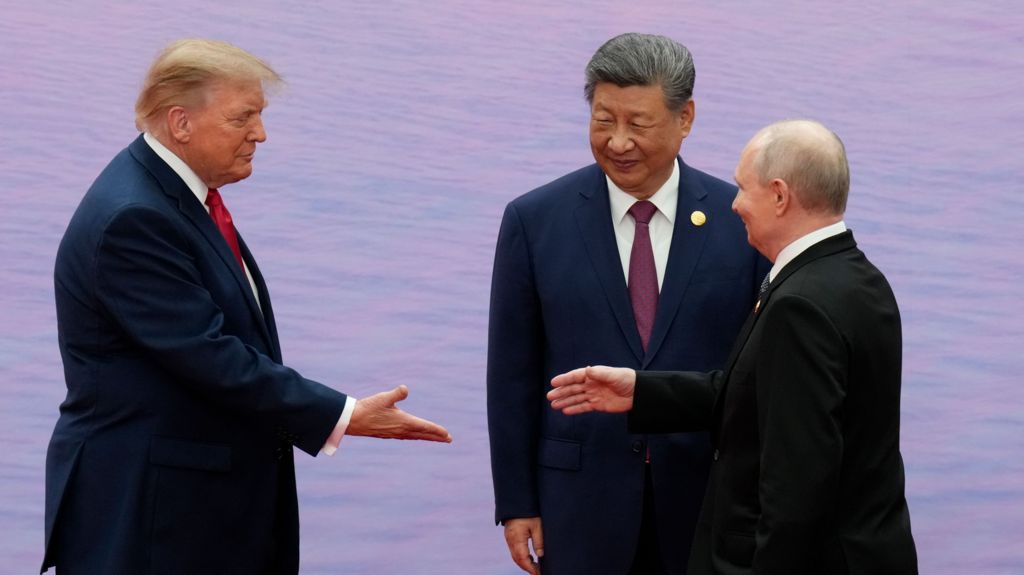
In a groundbreaking development, US President Donald Trump, Russian President Vladimir Putin, and Chinese President Xi Jinping have issued a joint declaration of peace following their first trilateral talks in Shenzhen, China. The historic meeting took place on the sidelines of the Asia-Pacific Economic Cooperation (APEC) summit. The leaders pledged to work towards reducing nuclear weapons and reforming the United Nations, while also addressing issues such as food and energy security. The trilateral discussion was marked by shared concerns over global challenges, with President Xi emphasizing the necessity of productive dialogue among major powers. While the meeting was characterized by warm sentiments, the leaders had varying agendas, particularly regarding the ongoing conflict in Ukraine.
In his opening remarks, President Xi stressed the importance of positive interaction among major powers. President Putin highlighted the shared interest in ending the Ukraine war and securing food and energy supplies. Trump underscored the unique position of these three nations to discuss nuclear disarmament and combat nuclear proliferation, specifically referencing ongoing efforts with Iran. However, the leaders' positions on the Ukraine conflict remain disparate, with Putin rejecting ceasefire offers and insisting on maximalist demands, while Kyiv and its allies accuse Russia of tacit support.
The meeting in Shenzhen comes after a significant gap in Trump and Putin's one-on-one meetings, which resumed ahead of the trilateral discussion. President Trump described the relationship between the three world powers as carrying a "special responsibility" to maintain dialogue. Despite the diplomatic overtures, the leaders' objectives for the meeting were not uniform, indicating potential challenges in achieving their stated goals.
The trilateral meeting was significant not only for its content but also for its symbolism, potentially marking a new era of multilateral diplomacy among global powers. However, the complexities of the issues at hand and the leaders' disparate agendas suggest that the road to peace and cooperation will be fraught with challenges. As the world watches, the outcomes of this historic meeting could shape the course of international relations for years to come.