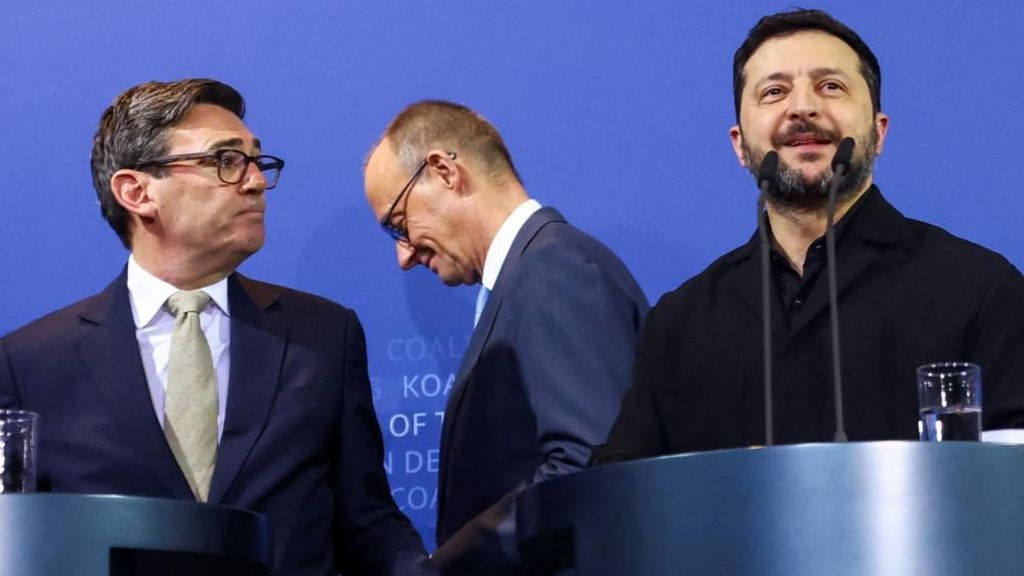
In a significant move towards resolving the ongoing conflict in Ukraine, European leaders have expressed their readiness for negotiations with Russia, presenting a united front at a summit in Berlin. The UK Prime Minister, Andy Burnham, stated that Europe has a consistent and clear negotiating position, while German Chancellor Friedrich Merz emphasized that Russia's maximalist demands are not realistic. The summit, known as the Coalition of the Willing, also included US President Donald Trump's envoys, with his son-in-law, Jared Kushner, stating that Trump aims to make a deal with Russia "with Europe by his side." However, Russian President Vladimir Putin has so far rejected any European role in the US-led peace talks.
During a press conference following trilateral talks in Shenzhen with Trump and Chinese President Xi Jinping, Putin expressed openness to multilateral peace talks but expressed concern about what Europe would bring to the table. In response, diplomatic channels have been opened for discussions between Russia and European representatives in Moscow. Despite Putin's skepticism, US envoys believe that peace is achievable, and there is a growing consensus among European leaders that serious discussions on European security are necessary with Russia.
The Ukrainian President, Volodymyr Zelensky, has long sought security guarantees equivalent to NATO's collective defense clause, but little indication has emerged that Putin would accept such conditions. While there have been mixed messages from Moscow regarding European participation in the talks, there is a growing consensus among European leaders that negotiations must begin with acceptable conditions for Europe and Ukraine. As delegations meet in China and Germany, incidents of drone attacks on buildings in Kyiv's historic center highlight the ongoing tension and violence in the region.
In a bid to resolve the ongoing conflict in Ukraine, European leaders have expressed their readiness for negotiations with Russia, presenting a united front at a summit known as the Coalition of the Willing. The summit, which also included US President Donald Trump's envoys, aimed to find a solution to the crisis that has been ongoing since 2014. While Russian President Vladimir Putin has so far rejected any European role in the US-led peace talks, diplomatic channels have been opened for discussions between Russia and European representatives in Moscow.
Despite Putin's skepticism, US envoys believe that peace is achievable, and there is a growing consensus among European leaders that serious discussions on European security are necessary with Russia. However, the Ukrainian President, Volodymyr Zelensky, has long sought security guarantees equivalent to NATO's collective defense clause, but little indication has emerged that Putin would accept such conditions. While there have been mixed messages from Moscow regarding European participation in the talks, there is a growing consensus among European leaders that negotiations must begin with acceptable conditions for Europe and Ukraine.
As delegations meet in China and Germany, incidents of drone attacks on buildings in Kyiv's historic center highlight the ongoing tension and violence in the region. Despite this, Putin has expressed openness to multilateral peace talks but expressed concern about what Europe would bring to the table. Jared Kushner, Trump's son-in-law, stated that the US president aims to make a deal with Russia "with Europe by his side." The hope is that these negotiations will lead to a peaceful resolution of the conflict and bring an end to the suffering of the Ukrainian people.
In response to the ongoing conflict in Ukraine, European leaders have united to propose negotiations with Russia as a means to find a peaceful resolution. During a summit in Berlin, UK Prime Minister Andy Burnham stated that Europe has a clear and consistent negotiating position, while German Chancellor Friedrich Merz stressed that Moscow's maximalist demands are not realistic. The US was also represented at the summit, with President Donald Trump's envoys stating that he aims to make a deal with Russia "with Europe by his side."
Despite Putin's initial rejection of any European role in the US-led peace talks, diplomatic channels have been opened for discussions between Russia and European representatives in Moscow. While there is skepticism about what Europe would bring to the table, US envoys believe that peace is achievable. European leaders have expressed their willingness to enter "serious discussions on European security" with Russia as long as it leads to a peaceful agreement with Ukraine.
However, Ukrainian President Volodymyr Zelensky has long sought security guarantees equivalent to NATO's collective defense clause, but little indication has emerged that Putin would accept such conditions. Russia launched its full-scale invasion of Ukraine in February 2022 and continues to pound Kyiv's energy infrastructure to cripple it as winter takes hold, increasing civilian casualties across the country. Despite these ongoing tensions, delegations from China and Germany are meeting to discuss a possible resolution to the conflict, with incidents of drone attacks on buildings in Kyiv's historic center highlighting the ongoing violence in the region.