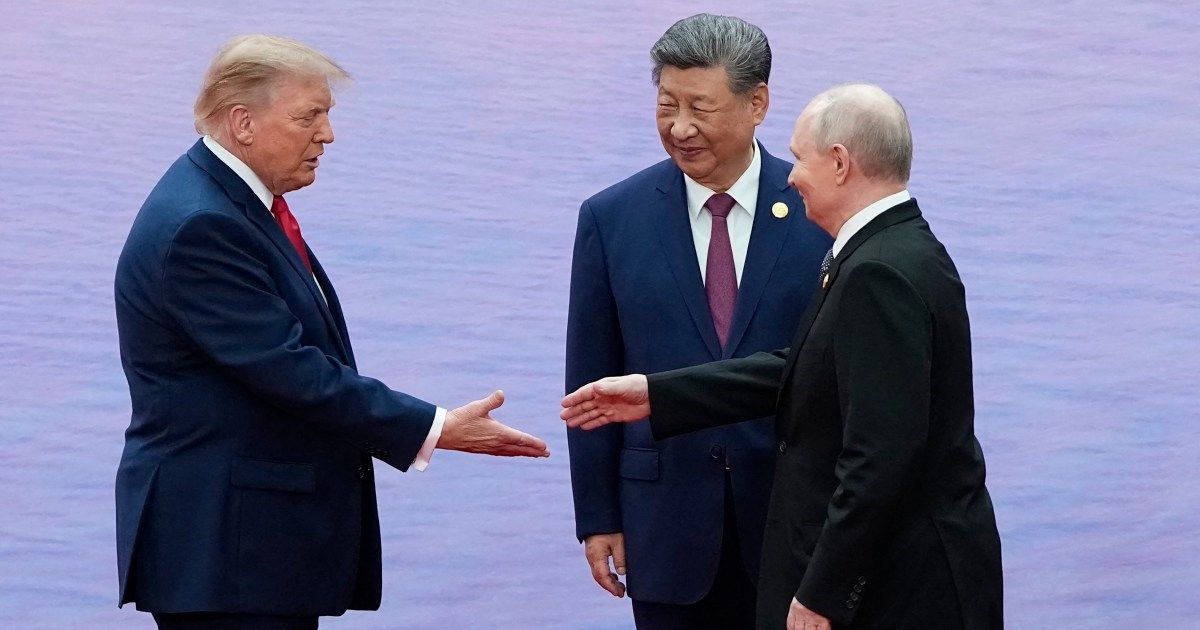
In a highly anticipated global gathering, US President Donald Trump, Chinese President Xi Jinping, and Russian President Vladimir Putin are set to hold their first three-way meeting in the southern Chinese city of Shenzhen on November 18th. This summit, which coincides with the Asia-Pacific Economic Cooperation (APEC) leaders' summit hosted by China, has sparked comparisons with the 1945 Yalta conference due to its historic significance. However, unlike the wartime Yalta Conference where allied powers agreed on the post-war order, these three world powers arrive at Shenzhen with distinct objectives and few concrete outcomes are expected.
The upcoming meeting follows Trump's visit to China after attending the Association of Southeast Asian Nations (ASEAN) meeting in Manila. The White House has announced that Trump will discuss the war with Iran and potential trilateral agreements on nuclear armament with Xi and Putin, while Ukraine is not anticipated to be a formal agenda item due to Xi's reluctance to engage in what he views as a European matter.
As tensions between traditional US allies escalate, Trump has suggested troop withdrawals from South Korea and cuts to assistance for Japan, while his administration considers China a primary geopolitical adversary. The Shenzhen meeting comes amidst strained relations between the US and China, with trade tariffs still high and friction persisting over rare earth mineral exports and alleged spying incidents. Despite low expectations for significant progress, a handshake without incident may be seen as a positive outcome.
Meanwhile, Trump's special envoys, Steve Witkoff and Jared Kushner, have brokered talks between Russia and Ukraine in Abu Dhabi on November 10th and 11th, marking the first direct discussions since February. These diplomatic efforts underscore the complex and interconnected nature of global affairs, as world powers navigate their respective interests and seek to shape the evolving geopolitical landscape.