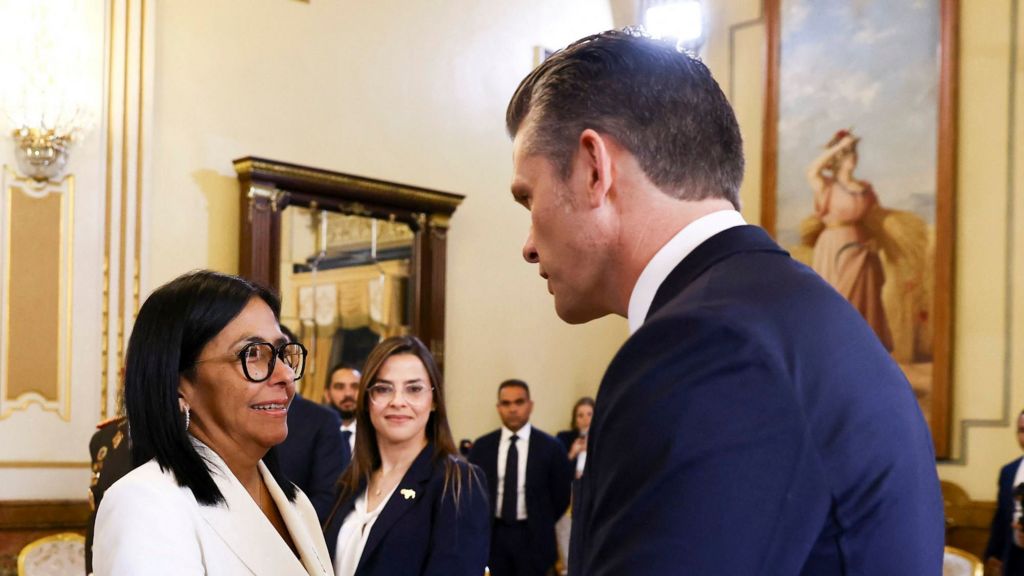
In a significant geopolitical shift, the United States and Venezuela have rekindled military ties less than a year after the ousting of Nicolás Maduro. On Wednesday, the interim government led by Delcy Rodríguez signed a military cooperation agreement with US Secretary of Defense Pete Hegseth. The deal comes as a surprise, given that military relations between the two countries were terminated in 2005 under Hugo Chávez's presidency. According to Hegseth, Venezuela has transformed from a hostile regional threat to a compliant security partner in less than twelve months. This transformation follows a US military raid on Maduro, who is now in custody in New York on drug-trafficking and conspiracy charges that he denies. The agreement aims to address common threats and will reportedly involve the training of Venezuela's armed forces and improvements in operational equipment and access to new technology. Hegseth emphasized that this partnership serves as a new chapter for both countries, the Venezuelan military, and the Western Hemisphere through the Americas Counter Cartel Coalition.
SUMMARY (CONTINUED):
The signing of this agreement marks a significant step in regional security dynamics, particularly given Venezuela's history of tense relations with the US. Under Maduro, relations had deteriorated significantly, reaching a low point late last year when the US offered a $50 million reward for information leading to his capture. The deal signals a potential shift in power and could have implications for neighboring countries, particularly Colombia, whose president, Abelardo de la Espriella, is an ally of the Trump administration. While details about the agreement are scarce, it appears to focus on addressing shared threats, which Hegseth identified as narco-terrorists using Venezuela as a safe haven.
SUMMARY (CONTINUED):
The revival of military ties between the US and Venezuela is not without controversy. Critics argue that this move could further destabilize the region, particularly given the ongoing power struggle in Venezuela. Moreover, the deal raises questions about the role of the US in regional affairs and its commitment to democratic principles, considering Maduro's controversial removal from power. Despite these concerns, Hegseth maintains that this partnership is crucial for regional security and will help combat drug trafficking and terrorism. As Hegseth travels to Colombia, it remains to be seen how this new chapter in US-Venezuela relations will unfold and what impact it will have on the region as a whole.