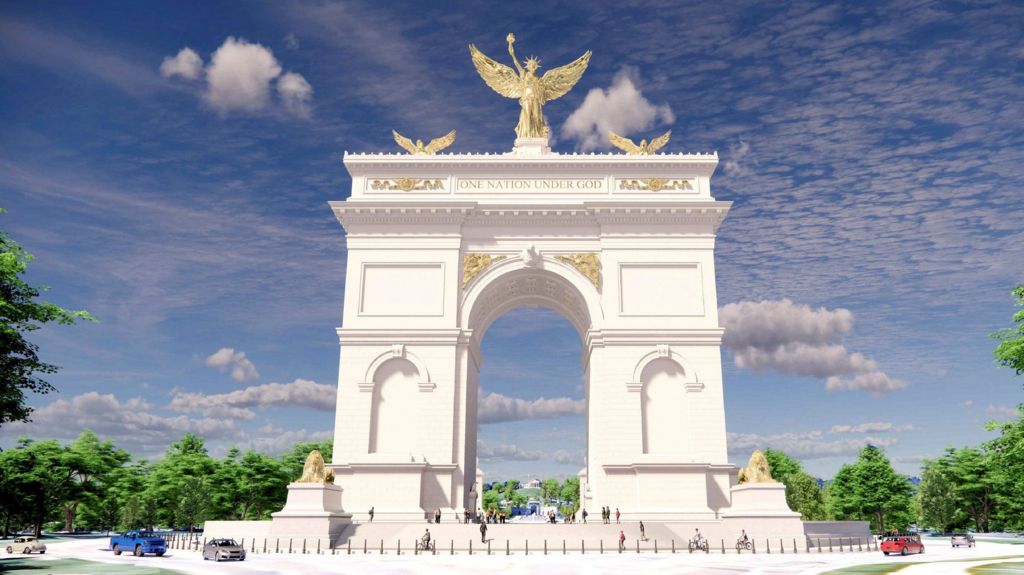
The descendants of former U.S. President John F. Kennedy have filed a lawsuit to halt the construction of a triumphal arch planned by President Donald Trump in Washington D.C., citing concerns that it would obstruct views of Kennedy's grave and other gravesites at Arlington National Cemetery in Virginia. The proposed 250ft structure, nicknamed the "Arc de Trump," has been designed to honor U.S. veterans buried at the cemetery but has faced opposition from the Kennedy family and others who argue it would mar historically significant sightlines and fundamentally alter visitors' experiences.
The legal battle began last week when a U.S. judge temporarily halted the project following a vote in favor of construction by the National Capital Planning Commission. The White House has expressed disappointment over the litigation, stating that the judiciary should not be used to politicize the structure. The Kennedy family's complaint contends that the arch would cast shadows on and damage sightlines to gravesites and memorials established in their honor at Arlington National Cemetery.
The lawsuit has been filed under a joint action by the state of Virginia and Washington D.C., seeking to block construction. Seven children of Robert and Ethel Kennedy, as well as their grandson, former Democrat congressman Joe Kennedy, and Ted Kennedy's son Edward Kennedy Jr., are among the plaintiffs. Notably absent is Trump cabinet official Robert F. Kennedy Jr., who heads the Department of Health and Human Services. The Kennedys also plan to intervene in two other lawsuits filed by conservationists and veterans seeking to halt construction.
The Kennedy family argues that the National Park Service and Interior Department approved construction without proper congressional authorization, scheduled for November 2026. The arch is one of several initiatives by Trump aimed at redesigning the capital city in commemoration of the country's 250th anniversary. Last year, he also added his name to the Kennedy Center, a major cultural institution in Washington D.C., an addition that was subsequently ruled illegal and removed.